

Maximizing Your Home’s Value and Efficiency with Tax Credits
The energy efficiency upgrades tax credit helps homeowners save money and reduce their environmental impact. These government programs incentivize improvements that cut energy use and lower utility bills.
Here’s a quick overview of key federal incentives:
In the U.S.:
- Energy Efficient Home Improvement Credit: Get 30% of project costs, up to $1,200 annually for insulation, windows, and doors. The limit increases to $2,000 for heat pumps and biomass stoves.
- Residential Clean Energy Credit: Claim 30% of the cost for renewable energy systems like solar panels and geothermal heat pumps, with no yearly limit.
In Canada:
- Canada Greener Homes Grant: Access up to $5,000 in rebates for renovations, plus up to $600 for energy audits. Eligible upgrades include insulation, windows, doors, heat pumps, and solar panels.
- Canada Greener Homes Loan: Apply for interest-free loans up to $40,000 for larger energy retrofits.
These incentives make it more affordable to create a comfortable, sustainable home. As the owner of Salt & Pepper Construction, John Doron helps homeowners steer improvements related to the energy efficiency upgrades tax credit, ensuring projects improve your home’s comfort and value.
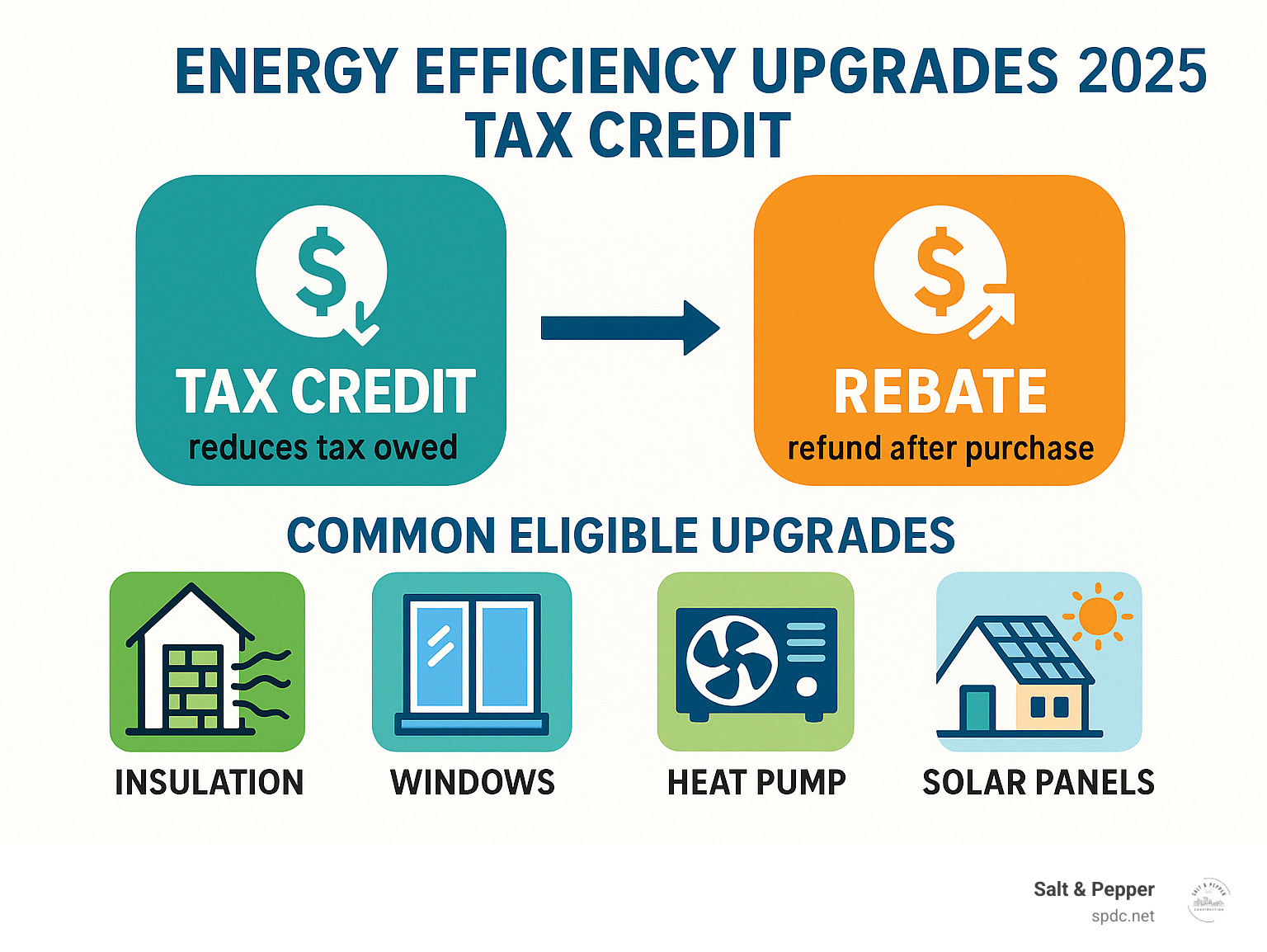
Energy efficiency upgrades tax credit terminology:
Understanding the Major Federal Energy Efficiency Tax Credit Programs (US & Canada)
Both the United States and Canada offer programs to help homeowners invest in energy efficiency, reduce emissions, and build a more sustainable future. Let’s review what each country offers.
The US Inflation Reduction Act (IRA) Incentives
The energy efficiency upgrades tax credit landscape in the U.S. was significantly improved by the 2022 Inflation Reduction Act. The IRA made existing tax credits more generous and accessible for homeowners.
Energy Efficient Home Improvement Credit is for upgrades that improve your home’s energy use. You can claim 30% of project costs with annual, but no lifetime, limits. Most improvements like insulation, windows, and doors are capped at $1,200 annually. Larger investments like heat pumps and biomass stoves have a higher cap of $2,000 annually.
Specific limits within the $1,200 cap include $250 per exterior door (up to $500 total), $600 for windows and skylights, and $150 for home energy audits. This is a nonrefundable credit, meaning it can reduce your tax liability to zero, but you won’t get a refund for any excess amount. The credit runs through December 31, 2032. For current details, visit the official Energy Efficient Home Improvement Credit page.
Residential Clean Energy Credit covers renewable energy systems. You can claim 30% of installation costs with no annual or lifetime dollar limits for most projects, such as solar panels or geothermal systems. The credit is 30% for 2022-2032, stepping down to 26% for 2033 and 22% for 2034. If your credit exceeds your tax liability, you can carry the excess forward to future years. Learn more at the Residential Clean Energy Credit page.
Canada’s Greener Homes Initiative
Canada’s Greener Homes Initiative combines grants and loans to help homeowners save money and fight climate change.
Canada Greener Homes Grant provides rebates from $125 to $5,000 for eligible upgrades. The program requires pre- and post-retrofit EnerGuide evaluations by certified advisors. It also contributes up to $600 toward evaluation costs, for a maximum total grant of $5,600 per household. Eligible upgrades include insulation, air sealing, windows, doors, heat pumps, and solar systems. The deadline to complete projects and request the grant is December 31, 2025.
For larger projects, the Canada Greener Homes Loan offers interest-free financing from $5,000 to $40,000 with a 10-year repayment term.
The Oil to Heat Pump Affordability Program helps homeowners switch from oil heating to heat pumps, offering up to $10,000 (or more in partnering provinces). This program often doesn’t require a home energy evaluation.
What Home Improvements Qualify for Credits and Rebates?
Knowing which improvements qualify is key to open uping these valuable incentives. Whether replacing drafty windows or upgrading your heating system, a program can likely help offset the costs. Let’s explore the types of home improvements that qualify for federal incentives in the US and Canada.
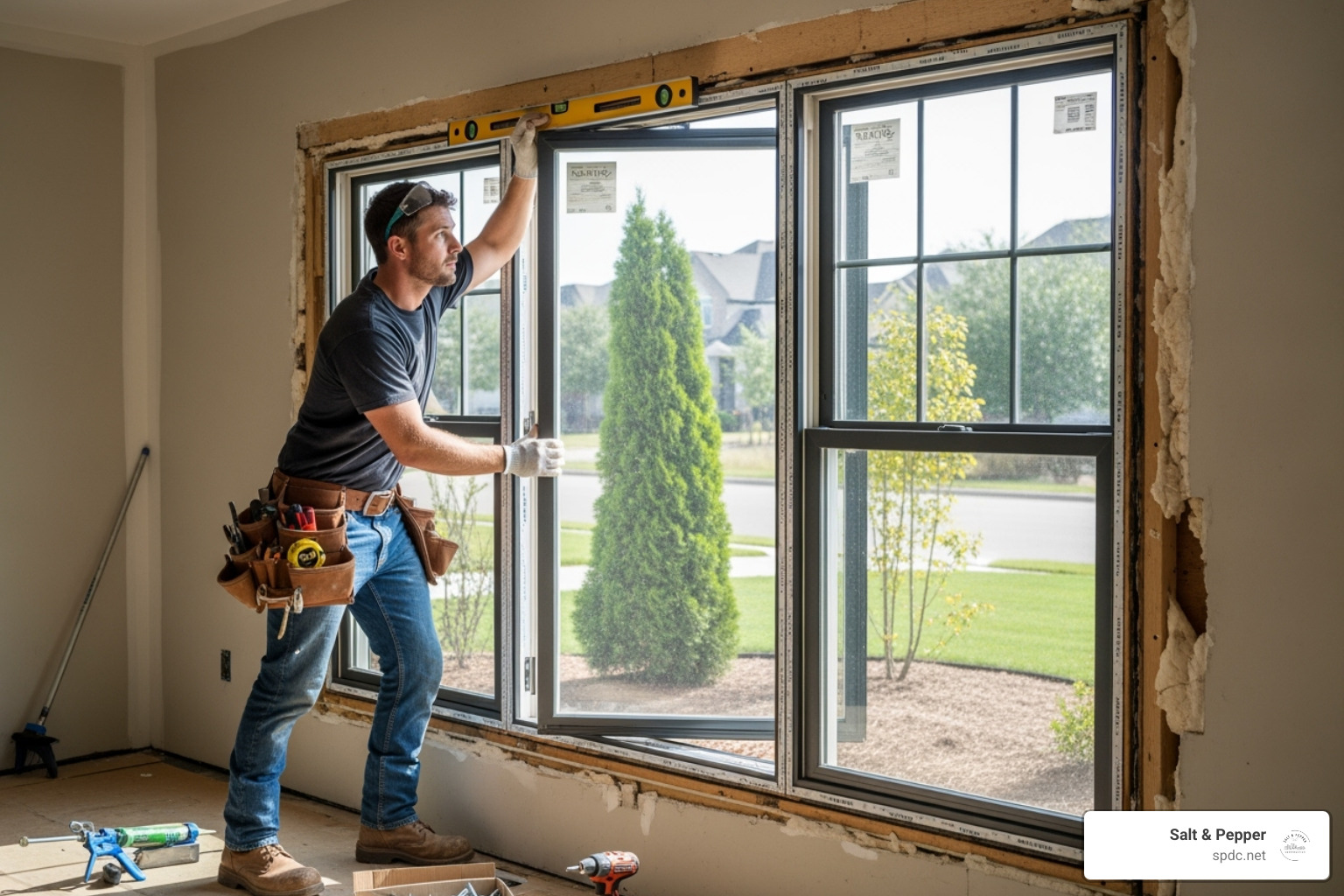
Building Envelope Upgrades
The building envelope is the barrier between your home’s interior and exterior. Improving it is often the most impactful step in reducing energy use.
- Insulation: A highly effective upgrade. The US offers a credit for 30% of material costs, up to $1,200 annually. Canada provides grants from $210 to $5,000. Materials must meet specific standards (IECC in the US, R-value/RSI in Canada). A home insulation upgrade is a great investment.
- Air Sealing: This addresses drafts and leaks. In the US, costs for products like caulk and weather stripping fall under the $1,200 annual cap (30% of cost). In Canada, grants can reach up to $1,000 based on improved airtightness.
- Windows, Skylights, and Exterior Doors: Replacing old units reduces heat transfer. The US offers a 30% credit, up to $600 annually for ENERGY STAR windows/skylights and up to $250 per door ($500 total). Canada offers grants from $125 to $5,000 for ENERGY STAR models.
High-Efficiency HVAC and Water Heating Systems
Upgrading HVAC and water heaters, which are major energy consumers, can lead to significant savings and qualify for a large energy efficiency upgrades tax credit.
- Heat Pumps: These efficient systems provide both heating and cooling. The US offers a 30% tax credit, up to $2,000 annually, for models meeting CEE highest efficiency tiers. Canada offers grants from $1,000 to $5,000+.
- Water Heaters: In the US, ENERGY STAR certified heat pump water heaters qualify for a 30% credit up to $2,000 annually. Efficient conventional models (gas, oil, propane) can get a 30% credit up to $600.
- Furnaces, Boilers, and Central AC: In the US, high-efficiency models can qualify for a 30% tax credit up to $600 annually if they meet strict CEE or ENERGY STAR criteria. These are generally not eligible in Canada, which prioritizes heat pumps.
For more on efficient systems, see our guides on energy efficient HVAC systems and energy efficient plumbing systems.
Here’s a simplified comparison of efficiency requirements:

| System Type | US Tax Credit (25C) Eligibility (2023+) | Canadian Greener Homes Grant (Example) |
|---|---|---|
| Heat Pumps | 30% of cost, up to $2,000/year. Must meet CEE highest efficiency tier. | Grants $1,000-$5,000+. Must be cold-climate model, meet specific performance ratings. |
| Heat Pump Water Heaters | 30% of cost, up to $2,000/year. Must be ENERGY STAR certified. | Included in space and water heating grants, must meet specific performance ratings. |
| Central Air Conditioners | 30% of cost, up to $600/year. Must meet CEE highest efficiency tier. | Generally not eligible unless part of a broader heat pump system. |
| Natural Gas Furnaces | 30% of cost, up to $600/year. Must meet CEE highest efficiency tier. | Generally not eligible (except northern/off-grid communities), focus is on heat pumps. |
| Biomass Stoves/Boilers | 30% of cost, up to $2,000/year. Must have 75% or higher efficiency rating. | Included in space and water heating grants, must meet specific performance ratings. |
Note: Specific efficiency tiers and criteria are subject to change. Always check the latest official requirements.
Renewable Energy and Other Upgrades
Other improvements can reduce fossil fuel reliance and qualify for an energy efficiency upgrades tax credit.
- Solar Panels (PV) and Geothermal Heat Pumps: In the US, these qualify for the Residential Clean Energy Credit (30% of cost, no cap). In Canada, solar PV systems are eligible for grants up to $5,000.
- Battery Storage: In the US, battery storage (3 kWh+) now qualifies for the 30% Residential Clean Energy Credit.
- Home Energy Audits: The US offers a credit for 30% of an audit’s cost, up to $150. Canada contributes up to $600 for mandatory EnerGuide evaluations.
- Electrical Panel Upgrades & EV Chargers: In the US, panel upgrades (200 amps+) can qualify for a credit up to $600. EV chargers may also qualify for a credit up to $1,000 in certain areas.
These options provide a path for nearly every homeowner to improve their home’s efficiency. Learn more about energy efficient home systems.
Navigating the Energy Efficiency Upgrades Tax Credit: Eligibility, Limits, and Deadlines
Understanding the rules is crucial for claiming your energy efficiency upgrades tax credit. Knowing the details of eligibility, limits, and deadlines will make the process much more straightforward.

Who is Eligible? Homeowners vs. Renters
Eligibility depends on your property type and ownership status.
- US Homeowners: The Energy Efficient Home Improvement Credit applies to your principal residence for improvements to an existing home. The Residential Clean Energy Credit (for solar, geothermal, etc.) can apply to your principal residence (including new construction) and a second home.
- US Renters: You may claim credits for certain upgrades you pay for, such as central air conditioners, water heaters, furnaces, and heat pumps. You cannot claim credits for structural components like windows or doors.
- Canadian Homeowners: The Canada Greener Homes Grant and loan programs are primarily for homeowners of existing primary residences. Some provinces offer separate incentives for new energy-efficient construction.
- Canadian Renters: Options are more limited, but programs like the Canada Greener Homes Affordability Program aim to help tenants access retrofits.
Understanding your eligibility for eco-friendly home renovations is the first step.
Understanding Credit Limits and Expiration Dates
Financial limits and deadlines are key to your savings strategy.
- US Credits: The Energy Efficient Home Improvement Credit has annual caps that reset. The general limit is $1,200 annually, with a higher $2,000 annual limit for heat pumps, heat pump water heaters, and biomass stoves. Specific items have sub-limits (e.g., $600 for windows, $500 for doors). This credit runs through December 31, 2032. The Residential Clean Energy Credit has no annual or lifetime dollar limits, but the credit percentage steps down from 30% after 2032, expiring after 2034.
- Canadian Programs: The Canada Greener Homes Grant is capped at $5,600 total per household ($5,000 for retrofits + $600 for evaluations). The Canada Greener Homes Loan offers up to $40,000 interest-free. A key deadline is December 31, 2025, by which all work must be completed and payment requested.
Timing your installation around these limits and deadlines can significantly impact your savings on rebates for upgrading HVAC.
How to Claim Your Tax Credits: Documentation and Forms
Attention to detail and good record-keeping are essential.
- Keep Detailed Records: Save all receipts and invoices that clearly separate material and labor costs.
- Get Manufacturer Certification Statements: This document proves your product meets efficiency standards and is crucial for US tax credits.
- File the Correct Forms: For US credits, you’ll file IRS Form 5695 with your tax return for the year the equipment was installed. For Canadian grants, the process is managed through the Natural Resources Canada portal using your pre- and post-retrofit EnerGuide evaluation reports.
We strongly recommend consulting a qualified tax professional for personalized advice. By staying organized, claiming your energy efficiency upgrades tax credit becomes much less stressful.
Maximizing Your Savings: Stacking Federal, State/Provincial, and Local Incentives
Federal programs are just the starting point. To truly maximize savings, combine incentives from federal, state/provincial, and local levels. This “stacking” approach can significantly reduce your out-of-pocket costs for major upgrades.

A Look at State and Provincial Rebate Programs
Many states and provinces offer their own programs that can be combined with federal incentives. These vary by region, so local research is essential.
- In Canada: Provinces like British Columbia (CleanBC), Ontario (Save on Energy), and Quebec (Rénoclimat) offer substantial rebates for heat pumps, insulation, and windows that complement federal grants. Other provinces have similar programs, so always check what’s available locally for home upgrade rebates.
- In the US: While the IRA provides large federal credits, many states also have their own energy efficiency programs. These can include rebates for specific appliances, solar installations, or even separate state tax credits.
These regional programs show a broad commitment to environmentally friendly home improvements.
Finding Local and Utility Company Rebates
Don’t overlook incentives from local municipalities and utility companies.
- Utility & Municipal Incentives: Many utility companies offer rebates for ENERGY STAR appliances or smart thermostats. Some cities also have loan programs for energy retrofits. These can often be claimed directly through the provider.
- Combining Incentives: It’s crucial to understand how different incentives interact. For US federal tax credits, utility subsidies must generally be subtracted from your project cost before calculating your credit. However, state incentives are often not subtracted.
To find all available incentives, US residents should use the Database of State Incentives for Renewables & Efficiency (DSIRE) at https://www.dsireusa.org/. Canadians should check their provincial energy agency or utility provider’s website. Diligent research can significantly reduce the cost of your energy efficiency upgrades tax credit projects.
Frequently Asked Questions about Energy Efficiency Upgrades Tax Credit
Here are answers to some of the most common questions about the energy efficiency upgrades tax credit, based on federal guidelines in the US and Canada.
Can I claim the energy efficiency upgrades tax credit for a home I’m building?
It depends on the credit and your location.
- In the US: The Energy Efficient Home Improvement Credit (25C) is for existing homes only. However, the Residential Clean Energy Credit (for solar, geothermal, etc.) can be applied to a newly built home that is your principal residence.
- In Canada: Most federal programs, like the Greener Homes Grant, are for retrofitting existing homes. However, some provinces have programs specifically for new, energy-efficient construction, so it’s worth checking for local incentives.
Are installation and labor costs included in the tax credit?
This varies by credit and the type of improvement.
- US Federal Tax Credits: For the Residential Clean Energy Credit (solar, geothermal), yes, labor costs for installation are included. For the Energy Efficient Home Improvement Credit (25C), labor is generally not included for building envelope items (windows, insulation) but is included for equipment like heat pumps, furnaces, and water heaters.
- Canada Greener Homes Grant: Both material and installation costs are generally included when calculating your grant amount for eligible retrofits.
Always keep detailed receipts that separate material and labor costs to simplify claiming your energy efficiency upgrades tax credit.
What happens if the credit I’m owed is more than the tax I owe?
This depends on the specific credit.
- US Federal Tax Credits: The Energy Efficient Home Improvement Credit (25C) is “nonrefundable.” It can reduce your tax bill to zero, but you won’t get a refund for the excess, nor can you carry it forward. The Residential Clean Energy Credit is also nonrefundable, but it has a key benefit: you can carry forward any unused credit to future tax years. This is a huge advantage for large investments.
- Canadian Federal Programs: These are primarily grants (direct payments) and loans, so the concept of a credit exceeding your tax liability does not apply in the same way.
Conclusion
Making your home more energy-efficient is a smart investment. It saves you money on utility bills, helps the environment, and increases your home’s comfort and value. With the right knowledge about the energy efficiency upgrades tax credit and available rebates, major eco-friendly home renovations become significantly more affordable.
For homeowners in the Tampa area, the team at Salt & Pepper is here to help you steer these upgrades. We know what qualifies and how to ensure your home improvements are done right, boosting your home’s comfort and value while helping you access available incentives. Ready to make your home smarter, greener, and more valuable? Let’s chat!


