

Why HVAC Rebates Are Your Gateway to Major Savings
Rebates for upgrading HVAC systems can put thousands of dollars back in your pocket while dramatically reducing your energy bills. Here’s what’s available right now:
Federal Programs (2025)
– 30% tax credit up to $2,000 for heat pumps
– 30% tax credit up to $600 for central air conditioners
– Up to $8,000 rebates through HEEHRA for qualifying households
– $150 credit for home energy audits
State & Local Programs
– California: Up to $1,500 through TECH Clean California
– Colorado: Up to $3,000 for cold climate heat pumps
– Ontario: Up to $12,000 for electric heating customers
– Hawaii: $1,250 instant rebates for central AC retrofits
Utility & Manufacturer Rebates
– PG&E: Up to $900 for high-efficiency heat pumps
– Duke Energy: Up to $300 for HVAC replacements
– Manufacturer rebates: $1,000-$1,650 from major brands
As energy efficiency becomes a national priority, homeowners who upgrade their HVAC systems can access an unprecedented number of rebate programs. The key is understanding how to layer federal tax credits, state rebates, utility incentives, and manufacturer promotions to maximize your savings.
Your heating and cooling system accounts for more than 40% of your annual energy costs. With the right combination of incentives, you could recover 30-50% of your upgrade investment while slashing your monthly utility bills.
I’m John Doron, owner of Salt & Pepper Construction, and I’ve helped countless Tampa homeowners steer the complex world of rebates for upgrading HVAC systems over the past decade. My experience has shown that proper planning and documentation can mean the difference between missing out on thousands in savings and maximizing every available incentive.

Rebates vs. Tax Credits: Decode Your HVAC Savings
Let’s clear up some confusion right away. When people talk about rebates for upgrading HVAC systems, they often mix up rebates and tax credits like they’re the same thing. They’re not – and understanding the difference can save you thousands of dollars.
Think of rebates as instant gratification. You get money back either at the point of sale or within a few weeks after installation. Your utility company might knock $500 off your heat pump installation right at checkout, or a state program might mail you a check after you submit your paperwork. Either way, you see the savings quickly.
Tax credits work completely differently. They’re dollar-for-dollar reductions in what you owe the IRS when you file your taxes. If you owe $3,000 in taxes and claim a $1,000 tax credit, you now owe $2,000. The catch? You have to wait until tax season to see that money.
Here’s where it gets interesting – you can often combine both! The federal Energy Efficient Home Improvement Tax Credit gives you 30% of your project costs back (with caps), while utility rebates can reduce your upfront costs. Just remember that any rebates you receive must be subtracted from your qualified expenses when calculating the tax credit.
| Feature | Rebates | Tax Credits |
|---|---|---|
| Timing | Instant or within weeks | Next tax filing season |
| Cash Flow | Reduces upfront costs | Reduces taxes owed |
| Administration | Utilities, states, manufacturers | IRS (federal) |
| Income Limits | Varies by program | None for most programs |
| Stacking | Can combine with tax credits | Can combine with rebates |
Why Understanding Incentive Types Matters
The timing difference between these programs can make or break your project budget. If you’re financing your HVAC upgrade, rebates help reduce what you need to borrow upfront. Tax credits require you to pay the full amount and wait months for relief.
Annual caps matter too. The federal tax credit has a $3,200 total annual limit – but here’s the good news: there’s no lifetime limit. You can claim the maximum each year through 2032 if you’re doing multiple home improvements.
Many rebate programs work on a first-come, first-served basis. I’ve seen Tampa homeowners miss out on substantial utility rebates because funding ran out before the official deadline. Don’t assume the money will be there when you’re ready – check funding status before you start shopping.
Common Myths That Cost Homeowners Money
The biggest myth I hear? “I can’t get both a rebate and a tax credit.” Absolutely false! You can stack them, but you need to subtract any rebates from your tax credit calculation. It’s still more money in your pocket.
Another costly misconception is that these programs are only for low-income families. While some programs like HEEHRA do target households earning up to 150% of area median income, most federal tax credits and utility rebates don’t care what you earn.
Here’s a reality check though – no combination of incentives will give you a completely free HVAC system. Even with maximum rebates and credits, you’ll still pay a significant portion of the upgrade cost. But those savings can easily reach $5,000 to $10,000 when properly combined.
One final warning: the principal residence rule is strict. Most tax credits only apply to your primary home, not rental properties or vacation houses. Make sure you’re clear on this before assuming you can claim credits on multiple properties.
Federal & Income-Based Programs for 2025
The Inflation Reduction Act has opened up a goldmine of federal incentives that make upgrading your HVAC system more affordable than ever. If you’ve been putting off that old, energy-guzzling system replacement, 2025 might be your year to finally make the switch.
The Energy Efficient Home Improvement Tax Credit is the star of the show, offering 30% of your project costs through 2032. What makes this especially attractive is that the annual caps reset every January 1st, so you’re not limited to a one-time benefit over your lifetime.
Here’s how the federal programs break down for rebates for upgrading HVAC systems:
The Energy Efficient Home Improvement Tax Credit (Section 25C) gives you 30% back on costs up to $2,000 for heat pumps and heat pump water heaters. If you’re installing a traditional central air conditioner, furnace, or boiler, you can claim 30% up to $600. Even that preliminary home energy audit qualifies for 30% up to $150.
The beauty of this program? No lifetime limits. You can claim the maximum amounts every single year through 2032, making it perfect for phased upgrades or future system replacements.
For households earning up to 150% of their area’s median income, the High-Efficiency Electric Home Rebate Act (HEEHRA) offers even more generous savings. We’re talking up to $8,000 for heat pumps – that’s not a tax credit you wait for, but actual rebate money that reduces your upfront costs.
The HOMES Rebate Program takes a whole-home approach, with rebates based on how much energy you actually save. Low- and moderate-income households get double the rebate amounts, making comprehensive energy upgrades surprisingly affordable.
One important change coming in 2025: manufacturers must assign a special four-digit code to each eligible product. You’ll need this Qualified Manufacturer (QM) code when filing your tax return. For the latest updates on these requirements, check the latest guidance on federal HVAC credits or use the explore incentives finder to see what’s available in your area.
Top Federal Rebates for Upgrading HVAC
HEEHRA represents the most generous federal rebates we’ve ever seen for HVAC upgrades, though they’re specifically designed for moderate-income households. If your family qualifies, you could receive $8,000 for a qualifying heat pump – enough to cover a significant portion of even a premium system.
But here’s something many homeowners overlook: you might also qualify for $4,000 toward electrical panel upgrades. Modern heat pumps often require updated electrical service, and this rebate helps cover that essential infrastructure improvement.
Heat pump water heaters get their own $1,750 rebate under HEEHRA. Since you’re already upgrading your heating and cooling, it’s the perfect time to consider replacing that old electric water heater too.
The challenge with HEEHRA is that it’s administered by individual states, and not all states have launched their programs yet. Some are still working through the logistics, so check with your state energy office to see what’s currently available.
Don’t sleep on the $150 credit for home energy audits. These professional assessments help identify which upgrades will give you the biggest bang for your buck. Many rebate programs actually require an audit, so this credit essentially pays for a service you’d need anyway.
Claiming Credits on IRS Form 5695
Filing for your federal tax credits means completing IRS Form 5695 with your annual tax return. The process is straightforward, but documentation is everything.
You’ll need the manufacturer’s certificate that shows your equipment meets efficiency standards. This usually comes in the box or is available on the manufacturer’s website. Keep your receipts for all equipment and installation costs – the IRS wants to see exactly what you spent.
Installation date documentation proves when the work was completed, which determines which tax year you can claim the credit. Starting in 2025, you’ll also need that manufacturer’s QM code for each piece of equipment.
The equipment must meet ENERGY STAR or CEE highest efficiency tier standards. It has to be installed at your principal residence (sorry, no credits for rental properties), and everything must be new equipment.
Here’s a detail that surprises many homeowners: labor costs qualify for heat pumps, water heaters, and biomass equipment. That means both the equipment and installation costs count toward your credit calculation.
Keep all your documentation for at least three years after filing. The IRS doesn’t audit these credits frequently, but when they do, they want to see everything. As someone who’s helped dozens of Tampa homeowners through this process, I can tell you that good record-keeping makes claiming these credits stress-free.
Layering State, Utility & Manufacturer Rebates for Upgrading HVAC
The real magic happens when you combine multiple incentive programs. Smart homeowners can stack federal tax credits with state rebates, utility incentives, and manufacturer promotions to dramatically reduce their net costs.
Finding Local Programs
Use the DSIRE database (Database of State Incentives for Renewables & Efficiency) to find programs in your area. The ENERGY STAR rebate finder lets you enter your ZIP code and see available utility and manufacturer rebates.
Types of State and Utility Rebates:
– Instant rebates: Applied at point of sale through participating contractors
– Mail-in rebates: Submit applications after installation
– Bill credits: Applied to future utility bills
– Tiered rebates: Higher amounts for more efficient equipment
Many programs have limited funding that operates on a first-come, first-served basis. We recommend applying as early in the program year as possible.
Spotlight Programs Across the Map
California TECH Clean California
– $1,500 rebate if existing AC and furnace are decommissioned
– $1,000 if existing equipment isn’t fully removed
– Requires ENERGY STAR certified, 2-stage or variable capacity heat pumps
– Can be layered with other incentives
Colorado Springs Utilities
– $900 for qualifying furnaces
– $1,500-$3,000 for heat pumps (higher amounts for cold climate models)
– $1,200 for qualifying boilers
– ENERGY STAR certification required
Ontario HER+ Program
– Up to $7,700 for Enbridge gas customers
– Up to $12,000 for electric heating customers
– Requires energy audit before application
– Program runs January 1 – December 31, 2025 (funding permitting)
Hawaii Energy
– $1,250 instant rebate for central AC retrofits
– $75 for AC tune-ups
– Up to $450 for mini-split systems
– Administered through Quality Contractor Network
For Tampa homeowners, check with Tampa Electric Company (TECO) and Peoples Gas for current rebate offerings. Programs change annually, so verify current availability before making purchase decisions.
Manufacturer & Contractor Promotions You Can Combine
Major HVAC manufacturers offer seasonal rebates that can be combined with government incentives:
Typical Manufacturer Rebates:
– Carrier: Up to $1,650
– Lennox: Up to $1,200
– Trane: Up to $1,000
These promotions often run from spring through early fall when demand is highest. Timing your purchase during promotional periods can add significant savings.
Quality Contractor Networks
Many utility and state programs require installation by approved contractors. These “Quality Contractor Networks” ensure proper installation and handle rebate paperwork submission. Working with approved contractors often streamlines the rebate process and may be required for eligibility.
At Salt & Pepper, we’re familiar with local rebate requirements and can help you steer the application process for Tampa, Clearwater, South Tampa, and Riverview area programs.
Step-by-Step Application Guide & Documentation Checklist
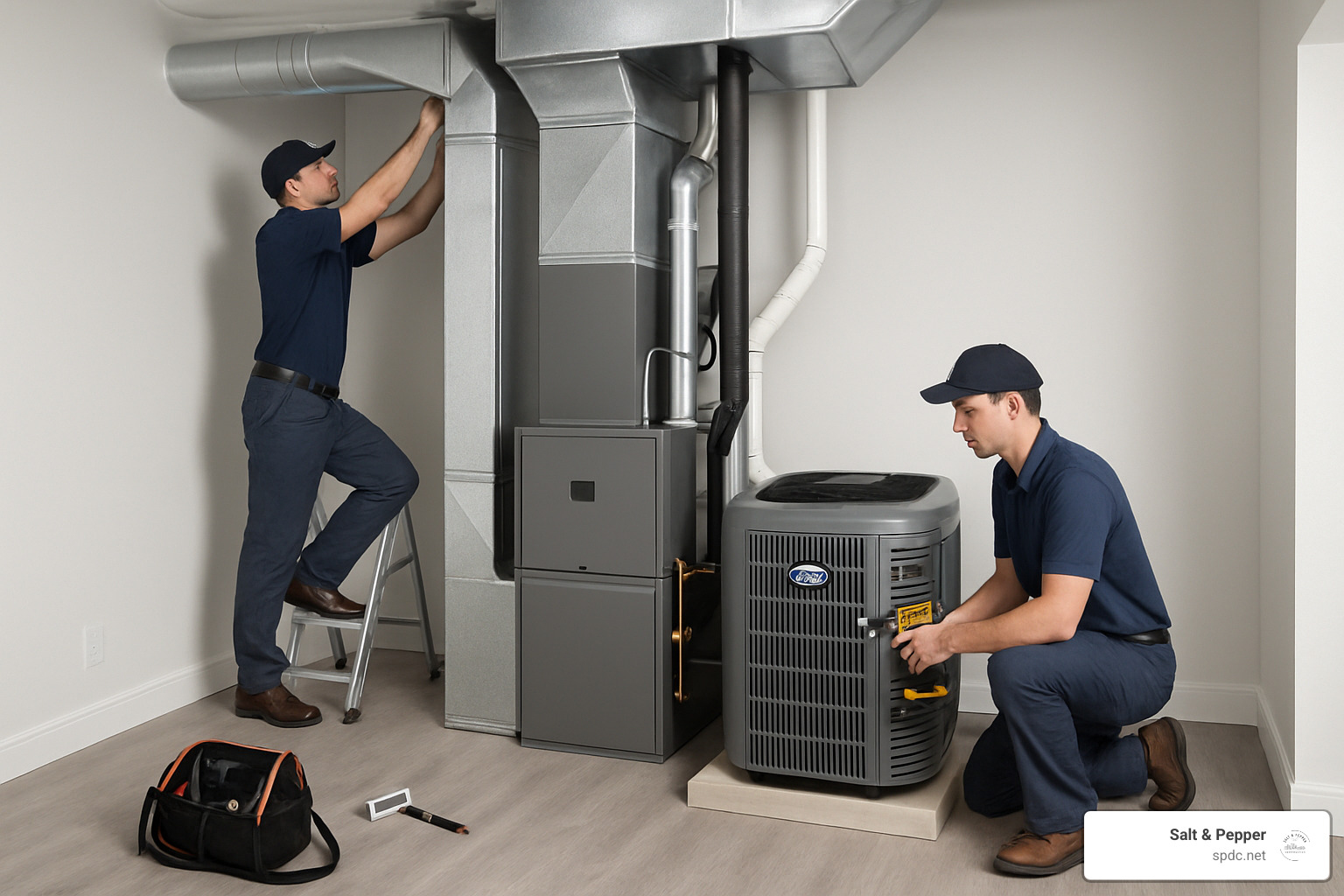
Successfully claiming rebates for upgrading HVAC systems requires careful planning and meticulous documentation. We’ve developed a systematic approach that ensures our clients maximize their savings while avoiding common pitfalls.
Pre-Installation Workflow:
1. Research available programs using DSIRE and utility websites
2. Schedule home energy audit if required by rebate programs
3. Get load calculation to properly size equipment
4. Compare qualifying models that meet efficiency requirements
5. Obtain multiple bids from approved contractors when required
6. Verify rebate funding availability before making purchase decisions
During Installation:
1. Document serial numbers and model numbers of all equipment
2. Keep all receipts for equipment and labor
3. Take photos of old equipment before removal
4. Ensure proper permitting and code compliance
5. Obtain manufacturer certificates showing efficiency ratings
Post-Installation:
1. Submit rebate applications within required timeframes
2. File tax credit documentation with annual return
3. Track application status through online portals
4. Keep records for at least three years
Pre-Purchase Steps: Locking in Rebates for Upgrading HVAC
Load Calculation is Critical
Before selecting equipment, have a qualified contractor perform a Manual J load calculation. This determines the correct system size for your home. Oversized or undersized equipment won’t perform efficiently and may not qualify for some rebates.
Qualifying Models Research
Not all high-efficiency equipment qualifies for rebates. Check specific requirements:
– SEER2 ratings: New efficiency standards took effect January 1, 2025
– ENERGY STAR certification: Required for most programs
– CEE highest tier: Some tax credits require equipment meeting Consortium for Energy Efficiency standards
Bid Comparison Strategy
Get quotes from at least three contractors, but ensure they’re all using qualifying equipment. The cheapest bid may not qualify for rebates, making it more expensive in the long run.
Rebate Funding Verification
Many programs have limited funding that can be exhausted mid-year. Call program administrators to verify funding availability before signing contracts. Some programs also have waiting lists when funding is depleted.
Post-Installation: Filing, Tracking & Avoiding Pitfalls
Invoice and Receipt Management
Keep detailed records of all costs:
– Equipment purchase receipts
– Installation labor invoices
– Permit fees
– Any related electrical work
For tax credits, you’ll need to subtract any rebates received from your qualified expenses. For example, if you paid $8,000 for a heat pump and received a $1,000 utility rebate, you can claim the tax credit on $7,000.
Serial Number Documentation
Many rebate programs require equipment serial numbers for verification. Take photos of equipment labels before they’re covered by installation. Some programs also require proof that old equipment was properly disposed of.
Online Portal Navigation
Most utility and state programs now use online application portals. Create accounts early and familiarize yourself with requirements. Upload clear, legible photos of all documentation.
Common Pitfalls to Avoid:
– Missing application deadlines (often 60-90 days after installation)
– Failing to use approved contractors when required
– Installing equipment that doesn’t meet efficiency requirements
– Not keeping manufacturer certificates for tax credit claims
– Forgetting to subtract rebates from tax credit calculations
For more detailed guidance on maximizing your home upgrade savings, check out our comprehensive guide on home upgrade rebates.

Frequently Asked Questions about Rebates for Upgrading HVAC
How much can I really save with combined incentives?
This is the question I hear most often from Tampa homeowners, and the answer might surprise you. Rebates for upgrading HVAC systems can cover anywhere from 25% to 70% of your project costs when you stack them properly.
Let me share some real-world examples from projects we’ve completed:
Tampa Heat Pump Installation – One of our recent customers invested $12,000 in a new heat pump system. They claimed the federal tax credit of $2,000 (the maximum 30% credit), received a $500 utility rebate from TECO, and took advantage of a $1,200 manufacturer promotion. Their total savings? $3,700, which brought their net cost down to just $8,300.
California Heat Pump with Full Electrification – A family member who moved to California spent $18,000 on a complete system upgrade. They combined the $2,000 federal tax credit with $1,500 from TECH Clean California, a $900 local utility rebate, and a $1,200 manufacturer rebate. Total savings of $5,600 reduced their investment to $12,400.
Low-Income Household Success Story – The most dramatic savings come from households qualifying for HEEHRA rebates. One family with a $15,000 heat pump installation received an $8,000 HEEHRA rebate, claimed a $2,000 federal tax credit on the remaining cost, and got a $500 utility rebate. They saved $10,500 – that’s 70% of their total project cost!
Most homeowners can realistically expect to recover 25-40% of their upgrade costs through combined incentives. The key is proper planning and understanding which programs you qualify for.
Can I claim both a rebate and a tax credit in the same year?
Yes, absolutely! This is one of the biggest misconceptions I encounter. You can definitely stack rebates for upgrading HVAC systems with federal tax credits in the same year.
Here’s the important part: you must subtract any rebates from your qualified expenses when calculating the tax credit. The IRS requires this adjustment to prevent double-counting the same costs.
Let me walk you through a typical calculation. Say you install a $10,000 heat pump system and receive a $1,000 utility rebate. Your qualified expenses for the tax credit become $9,000. The federal tax credit gives you 30% of $9,000, which equals $2,700. Your total savings are $3,700 – the $1,000 rebate plus the $2,700 tax credit.
The timing can get tricky. Some rebates appear as instant discounts at purchase, while others arrive as checks weeks after installation. Keep detailed records of when you receive each incentive to properly calculate your tax credit.
This stacking strategy is completely legal and encouraged by the government. They want to make energy-efficient upgrades as affordable as possible for homeowners.
What efficiency ratings must my new HVAC system meet?
Equipment efficiency requirements were updated in 2025, and they’re more stringent than before. The good news is that most quality systems we install already exceed these minimums.
Federal tax credit requirements are now based on the new SEER2 rating system. For split system central air conditioners, you need SEER2 ≥ 17.0 and EER2 ≥ 12.0. Packaged central AC units require SEER2 ≥ 16.0 and EER2 ≥ 11.5. Heat pumps must meet ENERGY STAR criteria, and gas furnaces need AFUE ≥ 95%.
ENERGY STAR requirements are slightly lower but still represent high-efficiency equipment. Central AC and heat pumps need SEER2 ≥ 15.2, with heat pumps also requiring HSPF2 ≥ 7.5. Gas furnaces need AFUE ≥ 90%, while oil furnaces require AFUE ≥ 85%.
State and utility programs vary widely in their requirements. Some accept basic ENERGY STAR certification, while others demand higher efficiency tiers. We always verify specific requirements before recommending equipment to our clients.
My advice? Choose equipment that exceeds minimum requirements when your budget allows. Higher efficiency systems often qualify for larger rebates and provide greater long-term energy savings. The extra upfront cost usually pays for itself through additional incentives and lower utility bills.
Starting in 2025, manufacturers must provide a four-digit code for each qualifying product. We handle this documentation for our clients, but it’s another reason to work with experienced contractors who understand the rebate landscape.
Conclusion
Rebates for upgrading HVAC systems represent one of the best opportunities for homeowners to improve comfort while saving money. With federal tax credits offering 30% of costs, state and utility rebates providing thousands in additional savings, and manufacturer promotions adding even more value, there’s never been a better time to upgrade your heating and cooling system.
The key to maximizing your savings lies in understanding how to layer multiple incentive programs:
Your Action Plan:
1. Research local programs using DSIRE and utility websites
2. Schedule a home energy audit to identify the most cost-effective upgrades
3. Choose qualifying equipment that meets efficiency requirements for multiple programs
4. Work with approved contractors when required by rebate programs
5. Document everything and submit applications within required timeframes
6. Claim tax credits on IRS Form 5695 with your annual return
At Salt & Pepper, we’ve helped hundreds of Tampa Bay area homeowners steer this complex landscape. Our experience with local utility programs, permitting requirements, and rebate applications ensures you don’t leave money on the table.
Remember these key points:
– Rebates and tax credits can be combined for maximum savings
– Programs have limited funding that can be exhausted early
– Proper documentation is critical for successful claims
– Equipment must meet specific efficiency standards
– Professional installation is often required
The average homeowner can expect to recover 25-40% of their HVAC upgrade costs through combined incentives. For a typical $12,000 heat pump installation in the Tampa area, that could mean $3,000-$4,800 in total savings.
Don’t wait – many programs operate on first-come, first-served funding. Start researching your options today and take advantage of these unprecedented savings opportunities.
For more information on energy-efficient upgrades and how they can benefit your home, explore our guide on the best ways to improve home energy efficiency.

Ready to start your HVAC upgrade journey? Contact Salt & Pepper today for a consultation on maximizing your rebate opportunities while ensuring quality installation that will serve your Tampa Bay home for years to come.


