

Home Addition | St. Petersburg, FL
| Quick Guide Garage conversions typically deliver the strongest return on investment among common home addition types.Pinellas County zoning sets minimum setbacks that determine how far an addition can extend on a lot.Homes in flood zones may need to meet elevation requirements before an addition can be permitted.Second story additions cost more per square foot than ground level additions but avoid reducing yard space.A design build contractor can shorten the path from concept to permit by handling drawings and permitting together. |
Adding square footage to a St. Petersburg home is often more cost effective than buying a larger house in the same neighborhood, especially in areas close to downtown where lot sizes and home values have both climbed. Before choosing a design, it helps to understand the addition types available, the zoning and flood rules that apply, and how each option compares on return on investment.
Common Types of Home Additions
| Addition Type | Typical Size | Best For | Notes |
| Garage Conversion | 300 to 500 sq ft | Home office, in-law suite, den | Fastest to complete, no new foundation needed |
| Family Room Bump-Out | 150 to 400 sq ft | Additional living space | Extends existing footprint on one side of the home |
| Primary Suite Addition | 300 to 600 sq ft | Adding a bedroom and bath | Often includes a walk-in closet and en suite bath |
| Second Story Addition | 600 to 1,200 sq ft | Homes on small lots | Adds space without reducing yard, higher cost per sq ft |
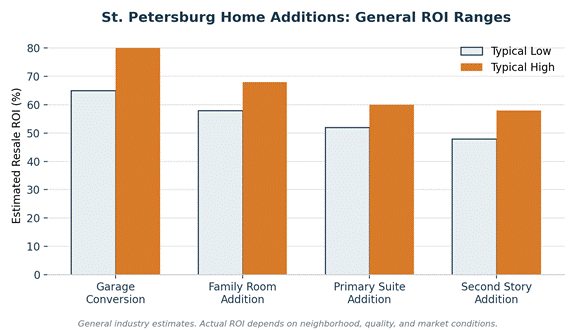
General estimated resale ROI ranges by home addition type. Actual results vary by neighborhood and market conditions.
Zoning and Setback Requirements
The City of St. Petersburg and Pinellas County set minimum setback distances from property lines, along with maximum lot coverage percentages. These rules determine how far an addition can extend toward the front, rear, or side of a lot. Corner lots and lots in designated historic districts often carry additional restrictions on height and placement.
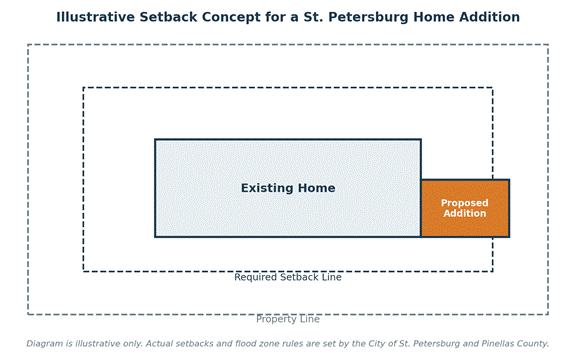
Illustrative concept of setback lines relative to an existing home and a proposed addition.
Flood Zone and Elevation Considerations
- Properties in FEMA designated flood zones may require the addition’s finished floor to meet a minimum elevation
- Substantial improvement rules can apply if the cost of the addition, combined with other recent work, exceeds a set percentage of the home’s value
- An elevation certificate is often required before permitting can move forward on waterfront or low lying lots
- A local contractor familiar with Pinellas County flood maps can flag these issues before design work begins, not after
Return on Investment by Addition Type
Garage conversions tend to deliver the strongest return relative to cost because they use an existing structure and foundation. Family room additions and primary suite additions perform well in neighborhoods where comparable homes already have that square footage. Second story additions cost more per square foot to build, largely due to structural reinforcement of the existing first floor, but they avoid reducing usable yard space, which matters on smaller St. Petersburg lots.
Planning Timeline
- Design and engineering: 3 to 6 weeks depending on complexity
- Permitting review: 4 to 8 weeks in Pinellas County, longer for waterfront or historic districts
- Construction: 8 to 16 weeks depending on addition size and whether existing systems need upgrades
Working With a Design Build Team in St. Petersburg
A design build contractor manages architectural drawings, engineering, and permitting under one contract, which removes the delays that come from coordinating separately with an architect, an engineer, and a builder. Salt & Pepper Construction’s home addition team serving St. Petersburg walks homeowners through zoning review, flood zone questions, and permitting from the first meeting.
Homeowners who are still deciding between adding space and remodeling within the existing footprint may find our kitchen layout and design trends guide for St. Petersburg helpful as a comparison.
Frequently Asked Questions
What type of home addition has the best ROI in St. Petersburg?
Garage conversions generally deliver the strongest return relative to cost because they reuse an existing structure and foundation. Family room and primary suite additions also perform well, especially in neighborhoods where comparable homes already have that square footage.
How long does it take to get a home addition permitted in Pinellas County?
Permitting review typically takes 4 to 8 weeks, though homes in flood zones, historic districts, or waterfront areas can take longer due to additional review requirements.
Do I need an elevation certificate for a home addition?
It depends on the property’s flood zone designation. Homes in FEMA designated flood zones, particularly near the waterfront, often need an elevation certificate before permitting can proceed.
How much yard space will an addition take up?
That depends on setback requirements set by the City of St. Petersburg and Pinellas County, which vary by lot size, zoning district, and whether the lot is a corner lot. A second story addition avoids reducing yard space entirely since it builds up rather than out.
Is a garage conversion the same as a home addition? A garage conversion repurposes existing enclosed square footage rather than adding new building footprint, which generally makes it faster and less expensive than a ground level bump-out or a second story addition.


