
What Does an Asphalt Millings Driveway Actually Cost?
Asphalt millings driveway cost typically falls between $3 and $8 per square foot installed, or $10 to $20 per ton for materials alone. Here’s a quick breakdown:
| Cost Type | Typical Range |
|---|---|
| Materials (per ton) | $10 – $20 |
| Materials (per sq ft) | $2 – $5 |
| Labor (per sq ft) | $5 – $7 |
| Installed total (per sq ft) | $3 – $8 |
| Average project total | $7,875 – $22,625 |
| Small driveway (200 sq ft) | $600 – $1,600 |
| Standard driveway (~600 sq ft) | $1,020 – $4,500 |
| Delivery per truckload | $30 – $100 |
Prices reflect 2026 U.S. national averages. Your actual cost will vary based on project size, base prep, and local labor rates.
You’ve got a driveway that needs work. New asphalt feels expensive. Gravel feels like a step backward. And then someone mentions asphalt millings – and suddenly you’re wondering if this recycled material is the budget-friendly middle ground you’ve been looking for.
It very well might be. Asphalt millings – also called Reclaimed Asphalt Pavement (RAP) – are ground-up pieces of old road and parking lot surfaces. They cost 6 to 15 times less per ton than new hot-mix asphalt. And unlike gravel, they self-cement over time when exposed to heat and compaction, creating a firmer surface than you might expect.
But the price range is wide. A small driveway might run you under $1,000. A large rural drive can climb past $20,000. Getting to your number means understanding what drives the cost up – and where you can trim it down.
I’m John Doron, owner of Salt & Pepper Construction in Tampa, Florida. I’ve helped homeowners navigate paving decisions like this one throughout the Tampa Bay area, including how asphalt millings driveway cost compares to other options given Florida’s heat, rain, and drainage challenges. Let’s break down exactly what you can expect to pay – and why.

Asphalt millings driveway cost vocabulary:
- asphalt driveway cost
- asphalt seal coat cost per square foot
- average cost of chip seal
Asphalt Millings Driveway Cost in 2026: Average Price per Square Foot and per Ton
When we look at the national average for an asphalt millings project in 2026, most homeowners land somewhere around $15,250. However, that figure is a bit like saying the average car costs $35,000—it doesn’t tell you if you’re buying a compact sedan or a heavy-duty truck.
For a residential driveway, the material itself is incredibly affordable. You’re looking at $10 to $20 per ton on average. If you are buying in smaller residential quantities (say, 10–25 tons), delivery might push that price closer to $15 to $40 per ton. When you factor in professional installation, the asphalt millings driveway cost per square foot typically ranges from $3 to $8.
Average asphalt millings driveway cost by project size
Size is the most obvious factor in your final bill. A standard two-car driveway in neighborhoods like Westchase or Carrollwood is often around 600 to 608 square feet.
- Small Driveway (200 sq ft): $600 – $1,600.
- Standard Two-Car Driveway (600 sq ft): $1,020 – $4,500.
- Large Residential/Basketball Court (3,000+ sq ft): $10,000 – $22,000+.

Cost per ton, coverage, and how much material you need
To figure out how much material to order, you need to know your coverage rates. Generally, one ton of asphalt millings covers 60 square feet at a 4-inch depth, or roughly 80 square feet at a 3-inch depth.
We use a specific tonnage formula to help our clients budget: (Length x Width x Depth in inches ÷ 12) ÷ 9 = Tons needed.
It’s important to remember the compaction factor. Millings are fluffy when they fall off the truck. To get a solid 4-inch driveway, you usually need to lay down about 5.5 inches of loose material. We also recommend adding a 5% to 8% waste factor to account for edges and compaction loss. For more detailed math, you can check out this Recycled asphalt millings cost and coverage guide.
10,000-square-foot asphalt millings driveway cost vs gravel vs new asphalt
For those with large rural properties in areas like Lutz or Wesley Chapel, a 10,000-square-foot driveway is a massive undertaking. Here is how the materials stack up for a project of that scale:
| Feature | Asphalt Millings | Gravel | New Hot-Mix Asphalt |
|---|---|---|---|
| Material Cost | $3,000 – $6,000 | $2,000 – $10,000 | $45,000 – $95,000 |
| Labor Cost | $10,000 – $30,000 | $5,000 – $15,000 | $20,000 – $40,000 |
| Total Estimated Cost | $13,000 – $36,000 | $7,000 – $25,000 | $65,000 – $135,000 |
| Lifespan | 15 – 20 years | 4 – 6 years | 20 – 30 years |
As you can see, millings offer a significant durability upgrade over gravel without the eye-watering price tag of a full hot-mix installation.
What Affects Asphalt Millings Driveway Cost the Most?
While the square footage gives us a baseline, the “hidden” costs often live in the dirt. Site preparation is where many budgets get stretched.
Prep work, drainage, and base conditions
If your current driveway is just soft Florida sand or clay-heavy soil, we can’t just dump millings on top and call it a day. Without a stable subgrade, your new driveway will develop ruts faster than you can say “pothole.”
Proper prep often involves:
- Excavation: Removing 4-8 inches of soil.
- Geotextile Fabric: A “road fabric” that prevents the millings from sinking into the soft soil.
- Base Stone: Adding 4-6 inches of crushed stone for stability.
- Drainage: In high-rain areas like Apollo Beach or South Tampa, we may need to install French drains or specific grading to ensure water doesn’t pool.
If you’re curious about the specifics of base preparation, you can find our 2026 asphalt driveway cost guide.
Labor, delivery, and material quality
Not all millings are created equal. Highway millings are usually the gold standard because they come from high-quality DOT mixes with consistent aggregate sizes. Parking lot millings can sometimes be “dirtier,” containing more dust or large chunks.
Labor costs typically range from $5 to $7 per square foot. This covers the crew, the skid steer for spreading, and the heavy vibratory roller needed for compaction. Delivery fees are usually modest – $30 to $100 per truckload – but if you live far from a recycling yard, those trips add up.
Tampa-area considerations that can change pricing
In the Tampa Bay region, our weather is a double-edged sword for millings. The intense Florida heat is actually great for millings because it helps the residual bitumen (the “glue” in asphalt) soften and re-bind. However, our heavy summer rains mean that drainage is non-negotiable.
Furthermore, if you are in South Tampa or within the City of Tampa limits, you may need a permit if you are altering the driveway footprint or tying into a public right-of-way. We always recommend checking with the Hillsborough County or City of Tampa Construction Services Division. For local expertise, learn more about our paving and sitework services in Tampa.
Installation Basics That Determine Whether Asphalt Millings Save You Money
The reason millings are so cost-effective is that they skip the energy-intensive heating process used for new asphalt. But to get that “self-cementing” benefit, the installation has to be precise.
Best thickness for an asphalt millings driveway cost payoff
For a standard residential driveway, we recommend a compacted thickness of 3 to 4 inches. If you regularly park heavy equipment, an RV, or a boat trailer, you should bump that up to 5 or 6 inches.
Laying it too thin (under 2 inches) is a recipe for failure; the material won’t have enough mass to bond properly, and you’ll end up with loose rocks that track into your garage.
Step-by-step installation process for lower long-term cost
- Excavation & Grading: Slope the area at least 2% away from your home.
- Base Layer: Lay down crushed stone if the soil is soft.
- The “Two-Lift” Rule: Never spread 6 inches of loose millings and try to compact them all at once. We spread in two lifts (3 inches each), compacting thoroughly after each pass.
- Watering: Lightly misting the millings can help the fines settle and improve compaction.
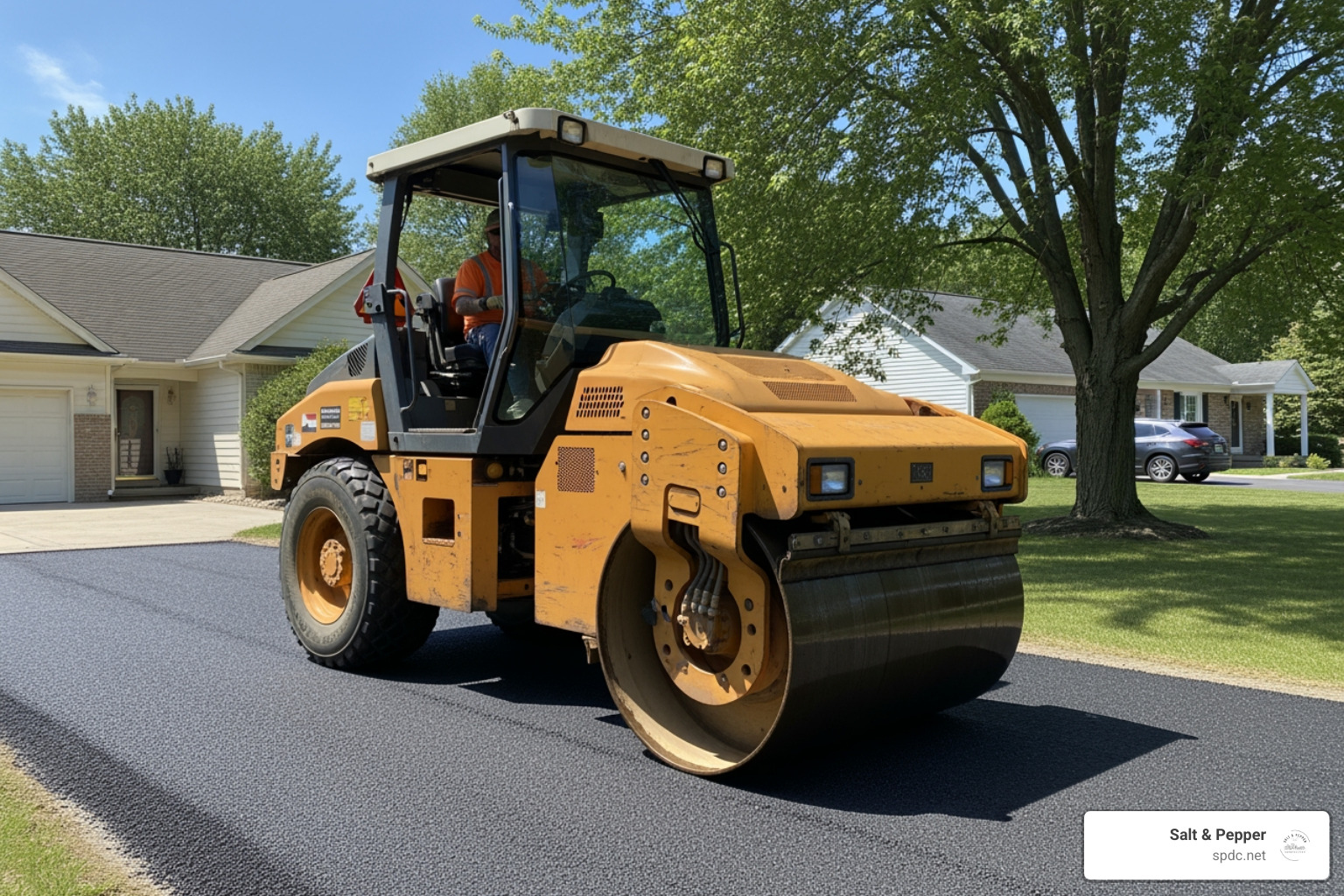
- Compaction: This is the most critical step. We use a heavy vibratory drum roller to achieve at least 95% compaction.
DIY vs hiring a pro for asphalt millings driveway cost
Can you do this yourself? Technically, yes. If you have a small project (under 1,000 sq ft) and access to a rental yard, you can save on labor.
DIY Tool List:
- Rented plate compactor or small roller ($75-$150/day)
- Skid steer or a very strong back and a rake
- Leveling string and stakes
However, the biggest risk with DIY is under-compaction. Without a heavy commercial roller, the millings may stay loose, leading to ruts and weeds. For larger driveways, the cost of renting equipment and the risk of a “botched” job usually make hiring a professional the smarter financial move. You can learn more about our driveway paving services in Tampa here.
Long-Term Asphalt Millings Driveway Cost: Maintenance, Lifespan, and Hidden Expenses
One of the best things about millings is that they actually get stronger over time. As they sit in the sun and get driven on, they continue to “bloom” and bond.
How long asphalt millings usually last
- With a proper base: 15 to 20 years.
- Without a base (laid on dirt): 8 to 12 years.
- Compared to new asphalt: New hot-mix lasts 20 to 30 years but requires more expensive maintenance like sealcoating.
Ongoing maintenance costs homeowners should expect
Unlike traditional asphalt, you should not sealcoat a millings driveway. Traditional sealants don’t bond well to the recycled surface and can actually cause damage.
Instead, expect these minor costs:
- Weed Treatment: Millings are semi-permeable, so weeds can occasionally pop through. A biannual herbicide treatment is usually enough.
- Top-Dressing: Every 3 to 5 years, you might want to add a thin “dusting” of fresh fine millings to fill in any surface voids.
- Re-compaction: If you notice soft spots after a particularly heavy rainy season, a quick pass with a rented roller can firm things right back up.
Ways to reduce maintenance and installation costs
If you’re looking to shave some dollars off the asphalt millings driveway cost, try these tips:
- Narrow the Design: Reducing the width of a long driveway by just 2 feet can save you thousands in materials and labor.
- Prep the Site Yourself: Clearing brush, removing old pavers, or killing weeds before the crew arrives can reduce your labor bill.
- Timing: Paving companies in Florida are often busiest in the spring. Booking during the “off-season” might net you a small discount.
- Check for Surplus: Sometimes contractors have “leftover” millings from a big highway job and will sell them to you at a steep discount just to avoid hauling them back to the yard.
For more help with the numbers, see How to estimate asphalt project costs.
Asphalt Millings vs Gravel: Which Is the Better Value?
This is the most common question we get at Salt & Pepper. Both are “loose” aggregates, but they perform very differently.
Cost, durability, and maintenance compared
Gravel is often the cheapest upfront option, but it is high-maintenance. It’s dusty, it washes out in heavy rain, and it needs to be “raked” or refilled almost every year.
Asphalt millings have a higher initial asphalt millings driveway cost than basic gravel, but because they bind together, they don’t wash away. They support heavier loads (up to 8,000 lbs per axle) compared to gravel’s 5,000 lbs limit. Over 10 years, millings are almost always the cheaper option because you aren’t constantly buying “top-up” loads.
Appearance, performance, and environmental pros and cons
- Aesthetics: Millings give you a dark, “paved” look that improves curb appeal more than grey gravel.
- Dust: Millings produce significantly less dust than gravel – a huge plus for your home’s HVAC filters and your car’s finish.
- Environment: RAP is the most recycled material in the U.S. Using it keeps old roads out of landfills and reduces the need for new oil-based binders. It may even qualify for LEED credits.
- Tracking: In the first year, millings can track a bit of “black dust” into the house. We recommend a good doormat until the surface fully cures.
For a deeper dive into these properties, check out What asphalt millings are and how they compare.
When gravel or new asphalt may be the smarter choice
Millings aren’t perfect for every situation.
- Gravel is better for very steep hills where even bound millings might struggle with erosion over time.
- New Hot-Mix Asphalt is the choice for luxury homes in Hyde Park or Bayshore where a perfectly smooth, jet-black finish is required for property value and HOA compliance. You can compare those costs here: asphalt driveway cost.
Frequently Asked Questions About Asphalt Millings Driveway Cost
Is asphalt millings good for a driveway?
Yes! They are a fantastic “middle-of-the-road” option. They are more durable than gravel, cheaper than new asphalt, and environmentally friendly.
How much does 1 ton cover and what thickness is best?
One ton covers about 80 sq ft at 3 inches thick. We recommend 3 to 4 inches for standard driveways.
What are the biggest drawbacks homeowners should know?
The surface is coarser than new asphalt. It can track some dark residue in the first few months, and it requires a full summer of heat to truly “set” and harden.
Conclusion: Is an Asphalt Millings Driveway Worth the Cost?
If you have a long driveway, a limited budget, or simply want a more durable alternative to gravel, an asphalt millings driveway is an exceptional value. In 2026, the asphalt millings driveway cost remains one of the smartest investments for rural and suburban properties alike.
At Salt & Pepper, we pride ourselves on helping Tampa homeowners find the right balance between quality craftsmanship and smart budgeting. Whether you’re in Brandon, Lutz, or right here in South Tampa, we can help you evaluate your site and decide if recycled asphalt is the right fit for your home.
Ready to upgrade your curb appeal without breaking the bank? Learn more about asphalt driveway costs and options and take the next step with Salt & Pepper.


