
What Does Flooring Installation Cost in 2026?
Flooring installation cost is one of the biggest line items in any home renovation budget — and the range is wide.
Here’s a quick snapshot of what most homeowners pay in 2026:
| Flooring Type | Total Installed Cost (per sq ft) |
|---|---|
| Carpet | $2.25 – $16 |
| Laminate | $3 – $13 |
| Luxury Vinyl Plank (LVP) | $4 – $10 |
| Ceramic Tile | $10 – $20 |
| Hardwood | $6 – $25 |
| Natural Stone | $15 – $32 |
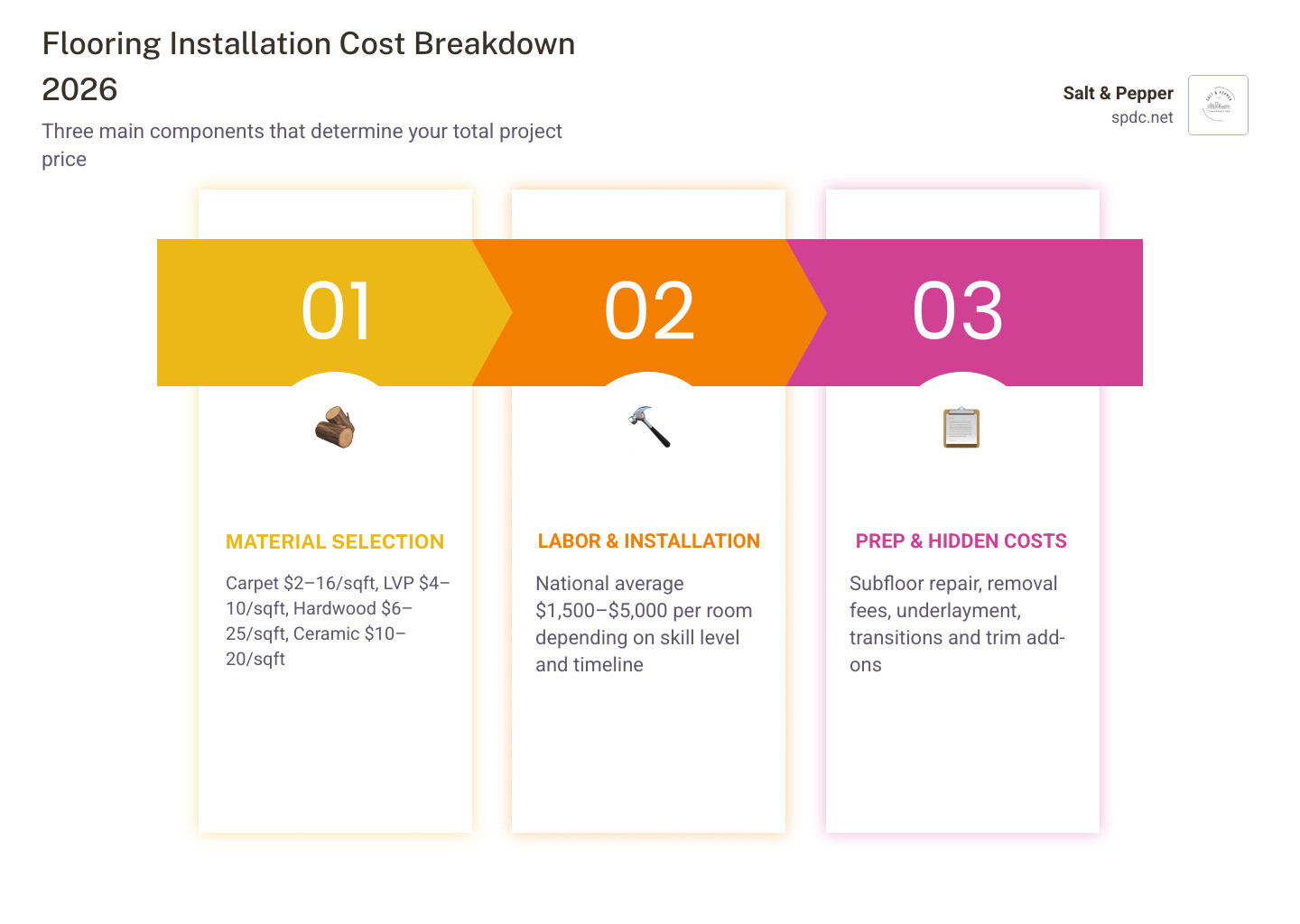
Most homeowners spend between $1,500 and $5,000 per room, with a national average around $4,000. Your final number depends on material choice, room size, subfloor condition, and where you live.
So why is it so hard to get a straight answer on cost? Because “install new floors” isn’t one thing — it’s a collection of separate decisions, each with its own price tag. Material, labor, prep work, removal, transitions, and trim all add up in ways that catch homeowners off guard.
This guide breaks it all down clearly, so you can walk into your project with a realistic budget and no surprises.
I’m John Doron, owner of Salt & Pepper Construction in Tampa, Florida, where I’ve helped homeowners navigate the full range of flooring installation costs across kitchens, bathrooms, living areas, and beyond. My hands-on experience with remodeling projects means I know exactly where budgets go wrong — and how to keep yours on track.
Average Flooring Installation Cost by Material
The fastest way to understand flooring installation cost is to start with the material. Some floors are inexpensive to buy but fussy to install. Others cost more up front but go down faster and last longer.
Here is a practical 2026 comparison for installed pricing, including both material and labor:
| Flooring Material | Material Cost per sq ft | Labor Cost per sq ft | Typical Installed Cost per sq ft | Best Fit |
|---|---|---|---|---|
| Hardwood | $3 – $15 | $4 – $8 | $6 – $25 | Living rooms, bedrooms, resale-focused projects |
| Luxury Vinyl Plank (LVP) | $2 – $8 | $1.50 – $3 | $4 – $10 | Kitchens, bathrooms, whole-home updates |
| Laminate | $2 – $6 | $1 – $5 | $3 – $13 | Budget-conscious dry areas |
| Ceramic Tile | $2 – $8 | $5 – $12 | $10 – $20 | Bathrooms, laundry rooms, kitchens |
| Carpet | $0.75 – $8 | $1.50 – $8 | $2.25 – $16 | Bedrooms, low-cost room refreshes |
A few takeaways jump out:
- Carpet is usually the cheapest to install.
- LVP is one of the best overall values in 2026 because it is durable, water-resistant, and relatively quick to install.
- Tile often has the highest labor cost because layout, leveling, cutting, setting, and curing all take time.
- Hardwood varies the most because species, plank width, finish type, and installation method can change pricing fast.
For a broader national overview, this 2026 flooring cost guide is useful, but local conditions in the Tampa area still matter. If you want to compare those national numbers to a local service breakdown, our Flooring Installation Services page is a good next step.
In homes across Tampa, Clearwater, Riverview, Wesley Chapel, Lutz, Palm Harbor, and nearby areas, we often see these patterns:
- LVP and tile are strong choices for Florida humidity.
- Engineered or solid hardwood may work beautifully in the right spaces, but moisture conditions must be considered carefully.
- Laminate can be cost-effective, though it is less forgiving in wet zones.
- Carpet remains a budget-friendly option for bedrooms, but many homeowners now prefer hard-surface flooring for easier cleaning and longer-term value.
Key Factors Influencing Your Total Project Estimate
The flooring itself is only part of the bill. In many real projects, the final total is driven by what happens before the first plank or tile is installed.

The biggest cost factors usually include:
- Square footage
- Flooring material
- Installation pattern and complexity
- Subfloor condition
- Removal of old flooring
- Disposal fees
- Room shape and obstacles
- Stairs, transitions, and trim work
- Moisture mitigation or leveling
A simple 200-square-foot bedroom is one thing. A kitchen with cabinets, appliances, doorways, and uneven subfloor is another. Same square footage, very different invoice.
Based on 2026 cost guides, many flooring quotes break down roughly like this:
- Materials: often 40% of total
- Labor: often 45% to 60% of total
- Subfloor prep: commonly $1 to $3 per sq ft, but more if repairs are extensive
- Removal and disposal: commonly $1.50 to $4 per sq ft
That last part is where sticker shock likes to hide.
If you have old glued-down flooring, cracked tile, water-damaged underlayment, or an uneven slab, prep can add up quickly. One of the best consumer-focused breakdowns of these line items is How Much Does Flooring Installation Actually Cost in 2026?. For local project planning, our Flooring Installation Tampa resource explains what homeowners should expect when budgeting for installation in this market.
Labor Rates and Regional Flooring Installation Cost
Yes, regional differences are real, even within Florida.
Research for 2026 shows metro labor rates commonly running higher than small-town rates, and Tampa-area pricing generally falls in the middle of the national range rather than at the very top. In one 2026 city comparison, Tampa flooring projects averaged just over $3,000, while some higher-cost coastal cities came in far above that.
That does not mean every Tampa project is cheap. It means the market is relatively balanced.
Labor rates often rise when a project involves:
- Condo access restrictions
- Multi-story homes
- Furniture moving
- Small rooms with many cuts
- Custom tile patterns
- Stair treads and risers
- Significant leveling or moisture work
In our service areas, labor also depends on whether the floor is being installed over wood subfloor or concrete slab. Many Florida homes sit on slab, which can simplify some jobs and complicate others. Moisture testing and flattening are often more important than homeowners expect.
If you are comparing local options, our guides on Flooring Installation in Tampa Expert Guide to Modern Home Flooring Solutions and Wood Floor Installation Tampa dig deeper into material-specific planning in the Tampa market.
Hidden Expenses in Flooring Installation Cost
If you only compare the price per square foot for the flooring product itself, you are seeing maybe half the story.
Here are the most common add-ons homeowners should expect:
- Underlayment: $0.50 to $5.40 per sq ft depending on product and sound/moisture needs
- Old flooring removal: $1.50 to $3.50 per sq ft
- Subfloor replacement: $3 to $10 per sq ft
- Leveling compound: often $1 to $4+ per sq ft where needed
- Baseboard or quarter-round replacement
- Transition strips between rooms
- Door trimming
- Furniture moving
- Appliance disconnect/reconnect
- Stairs priced separately
- Disposal and dump fees
- Moisture barriers for slab installations
These details matter because two quotes can look similar while covering very different scopes. One may include transitions, haul-away, and trim reset. Another may not. That is how a “great deal” suddenly develops expensive side quests.
A good estimate should clearly separate:
- Material
- Labor
- Tear-out
- Prep
- Underlayment
- Trim and transitions
- Disposal
- Any exclusions
That same quote discipline applies across other flooring categories too, including specialty finishes. For another example of how per-square-foot pricing can change based on prep and system type, see The Ultimate Breakdown of Epoxy Floor Price Per Square Foot.
DIY vs. Professional Installation: Is It Worth the Savings?
DIY can absolutely save money, but it does not always save sanity.
Research for 2026 suggests homeowners may save roughly $3 to $8 per square foot on labor by installing certain flooring types themselves, especially click-lock laminate or LVP. On paper, that looks attractive. In practice, the real answer depends on the material, the room, and your skill level.

DIY is most realistic for:
- Small, square rooms
- Click-lock laminate
- Some floating LVP products
- Projects with flat, clean subfloors
- Homeowners with time, patience, and the right tools
Professional installation is usually worth it for:
- Tile
- Hardwood
- Bathrooms
- Kitchens
- Large open layouts
- Stairs
- Uneven slabs
- Projects requiring warranty protection
Here is the practical comparison:
| Category | DIY | Professional Installation |
|---|---|---|
| Up-front cost | Lower | Higher |
| Time required | Higher | Lower |
| Tool purchases | Often needed | Usually included |
| Risk of mistakes | Higher | Lower |
| Warranty protection | Limited | Often better |
| Finish quality | Depends on skill | More consistent |
A few important realities:
- Tile is difficult to DIY well. A lippage problem or poor substrate prep can haunt you every day.
- Hardwood needs precise acclimation, fastening, spacing, and finish work.
- Even “easy” LVP can fail if the subfloor is not flat enough.
- Some flooring warranties are stronger when installed according to professional standards.
For local material-specific guidance, see our Laminate Flooring Installation Tampa and Ceramic Tile Flooring Installation Tampa pages.
Our honest view: DIY makes sense when the room is simple and the stakes are low. But when the floor is going into a kitchen, bathroom, or main living area, professional installation often pays for itself by preventing callbacks, repairs, and regret. Regret is a very expensive flooring accessory.
Frequently Asked Questions about Flooring Costs
How long does a typical flooring installation take?
Timelines depend on material, prep, and project size.
For a rough 2026 guide:
- Single room with floating flooring: about 1 day
- Multiple rooms: 2 to 4 days
- Whole-house installation: 3 to 7 days
- Tile: usually longer because of substrate prep, setting time, and grout curing
- Site-finished hardwood: longer still because sanding and finish drying add days
Some materials also need acclimation before installation:
- Hardwood commonly needs a few days in the home before installation
- Laminate and vinyl may need a shorter acclimation period depending on product and site conditions
One useful benchmark from 2026 reporting: a two-person crew can often install about 300 to 500 square feet of vinyl plank per day, including prep and transitions. Tile is slower. Carpet is often faster. Hardwood lands in the middle, depending on finish method.
The biggest schedule disruptors are usually:
- Furniture not cleared in advance
- Discovery of subfloor damage
- Moisture issues
- Waiting on special-order materials
- Condo or HOA scheduling restrictions
For a broad timeline overview, see How Much Does Flooring Installation Cost? (2026 Guide) | CostWhale.
What is the most cost-effective flooring for 2026?
For most homeowners in 2026, LVP is the value leader.
Why?
- It typically installs for about $4 to $10 per sq ft
- It is durable and low-maintenance
- It handles moisture better than hardwood and standard laminate
- It works well in kitchens, bathrooms, and many Florida homes
- It delivers a wood-look style at a lower price than real wood
That is why LVP keeps showing up in “best bang for the buck” conversations. It is not always the cheapest, but it often offers the best mix of price, durability, and appearance.
Carpet is cheaper in many cases, but it usually does not match LVP for durability or moisture resistance. Laminate can also be a strong value in dry spaces, especially when budgets are tight.
If you want a more detailed product-by-product breakdown, Cost to Install Vinyl Plank Flooring in 2026: Detailed Breakdown is a helpful external reference.
Does new flooring increase home resale value?
Often, yes.
New flooring improves how a home looks, feels, and photographs. That matters whether you are staying for years or thinking about resale.
In general:
- Hardwood tends to offer the strongest value perception
- Tile performs well in bathrooms and kitchens
- LVP offers strong practical appeal because it is durable and easy to maintain
- Worn carpet usually hurts buyer impressions more than homeowners realize
Some 2026 sources report hardwood delivering around a 75% ROI, though real resale impact depends on the neighborhood, the condition of the rest of the house, and whether the flooring choice fits the home.
In our Tampa-area market, buyers usually respond well to:
- Clean, cohesive flooring across main living areas
- Moisture-friendly materials
- Updated finishes that reduce immediate maintenance concerns
- Flooring choices that suit Florida living rather than fight it
For more on choosing wisely, visit Thinking About Flooring Service in Tampa How to Make the Right Choice.
Conclusion
A realistic flooring installation cost budget starts with the right questions:
- What material fits the room?
- What prep work is needed?
- What is included in the quote?
- Is this a DIY project or a pro job?
- What hidden costs could show up after tear-out?
Once you answer those, pricing gets much clearer.
Related: Whole-Home Remodeling Guide for Tampa Homeowners in Tampa FL
At Salt & Pepper, we help homeowners across Tampa, South Tampa, Clearwater, Riverview, Hyde Park, Westchase, Seminole Heights, Carrollwood, Brandon, Wesley Chapel, Lutz, Oldsmar, Valrico, Palm Harbor, Temple Terrace, New Tampa, and Apollo Beach plan flooring projects with fewer surprises and better results. Our approach combines design guidance, quality craftsmanship, and full project management, so the finished floor looks great and performs the way it should.
If you are comparing options now, start with more info about flooring services. You can also explore related resources like Everything You Need to Know About Flooring Companies in Tampa, Choosing the Best Flooring Company in Tampa, and Tampa Flooring Installation Transforming Your Space with Expertise Salt Pepper Construction.
The right floor should not just fit your home. It should fit your budget, your lifestyle, and your future plans too.


