

Understanding Your Asphalt Driveway Cost
Thinking about installing a new driveway? The asphalt driveway cost is often a key factor for homeowners. Here’s a quick look at what you can expect:
- Average Cost Per Square Foot: Expect to pay between $7 and $15 per square foot for materials and professional installation.
- Typical Overall Project Cost: Most homeowners spend between $3,128 and $7,391.
- Estimated Cost for 1,000 sq ft: A 1,000 square foot asphalt driveway can range from $4,500 to $10,000.
Asphalt driveways are a popular choice. They offer a durable, smooth surface that can last for years. They also boost your home’s curb appeal. But the final price depends on many things. This guide will help you understand all the factors that impact your paving project.
This guide comes from John Doron, owner of Salt & Pepper Construction. While John is known for high-quality kitchen and bathroom remodeling, his passion for home improvement extends to understanding the nuances of asphalt driveway cost.
Understanding the Average Asphalt Driveway Cost
Planning a new driveway can feel overwhelming, especially when you’re trying to figure out the budget. We get it – nobody wants any surprise costs halfway through their project! The good news is that asphalt driveway cost is pretty predictable once you know what goes into it.
Nationally, you’re looking at $7 to $15 per square foot for a professionally installed asphalt driveway. That includes everything – materials, labor, and all the behind-the-scenes work that makes your driveway last for decades.
Most homeowners end up spending between $3,128 and $7,391 for their entire project, with the sweet spot around $5,258. Of course, your final number depends on your specific situation, but this gives you a solid starting point for planning.
When we break down the costs, materials typically run $2 to $6 per square foot, while labor ranges from $1 to $7 per square foot. The wide range in labor costs reflects everything from basic site prep to complex grading work – some driveways are just trickier than others!
Cost Breakdown by Driveway Size
Here’s where size really matters. A bigger driveway needs more materials, more crew time, and frankly, more everything. But there’s a bit of good news – larger projects often get better per-square-foot pricing.
Small driveways around 200 square feet work great for single-car parking. You’re looking at roughly $1,400 to $2,600 total. The catch? Smaller jobs sometimes cost a bit more per square foot because contractors still need to bring the same equipment and crew.
A typical 2-car driveway (think 24 by 40 feet, or about 960 square feet) is what most of our clients end up with. The asphalt driveway cost for this size usually falls between $3,100 and $8,800. This is the sweet spot where you get good value without breaking the bank.
For a 1,000 square foot driveway, expect to budget $4,500 to $10,000. This size works well for families with multiple cars or those who want extra parking space. The range is wider here because factors like site preparation and local labor rates really start to show their impact.
Large driveways over 800 square feet can run $5,600 to $10,400 and up. While the total price climbs, you often get better efficiency on larger projects – think of it as the “bulk discount” of driveway installation.
Breaking Down the Asphalt Driveway Cost for a New Project
Let’s talk about where your money actually goes when you install a brand-new asphalt driveway. Understanding this helps you spot good contractors and avoid any surprises.
Materials eat up a big chunk of your budget – typically $2 to $6 per square foot. This covers the asphalt mix itself, which is basically hot gravel and sand held together with asphalt cement. Since asphalt is petroleum-based, prices can swing with oil costs. Most projects use between $100 and $200 worth of asphalt per ton.
Labor costs range from $1 to $7 per square foot, and there’s good reason for that spread. Simple, flat driveways with easy access cost less. Sloped lots, tight spaces, or complex drainage needs? That’s where you hit the higher end. You’re paying for skilled crews who know how to prep your site properly and lay asphalt that won’t crack in two years.
Equipment costs are usually rolled into your quote, but it’s worth knowing about them. We’re talking serious machinery here – excavators, graders, pavers, and those massive rollers that compact everything perfectly. This isn’t DIY-friendly equipment!
Permit fees might surprise first-time driveway owners. Most areas require permits for new driveways, costing $50 to $200. It’s not exciting, but it keeps everything legal and up to code.
Add it all up, and you get that $7 to $15 per square foot range we mentioned. This comprehensive approach means you’re getting a driveway built right from the ground up – literally.
Key Factors That Influence Paving Prices
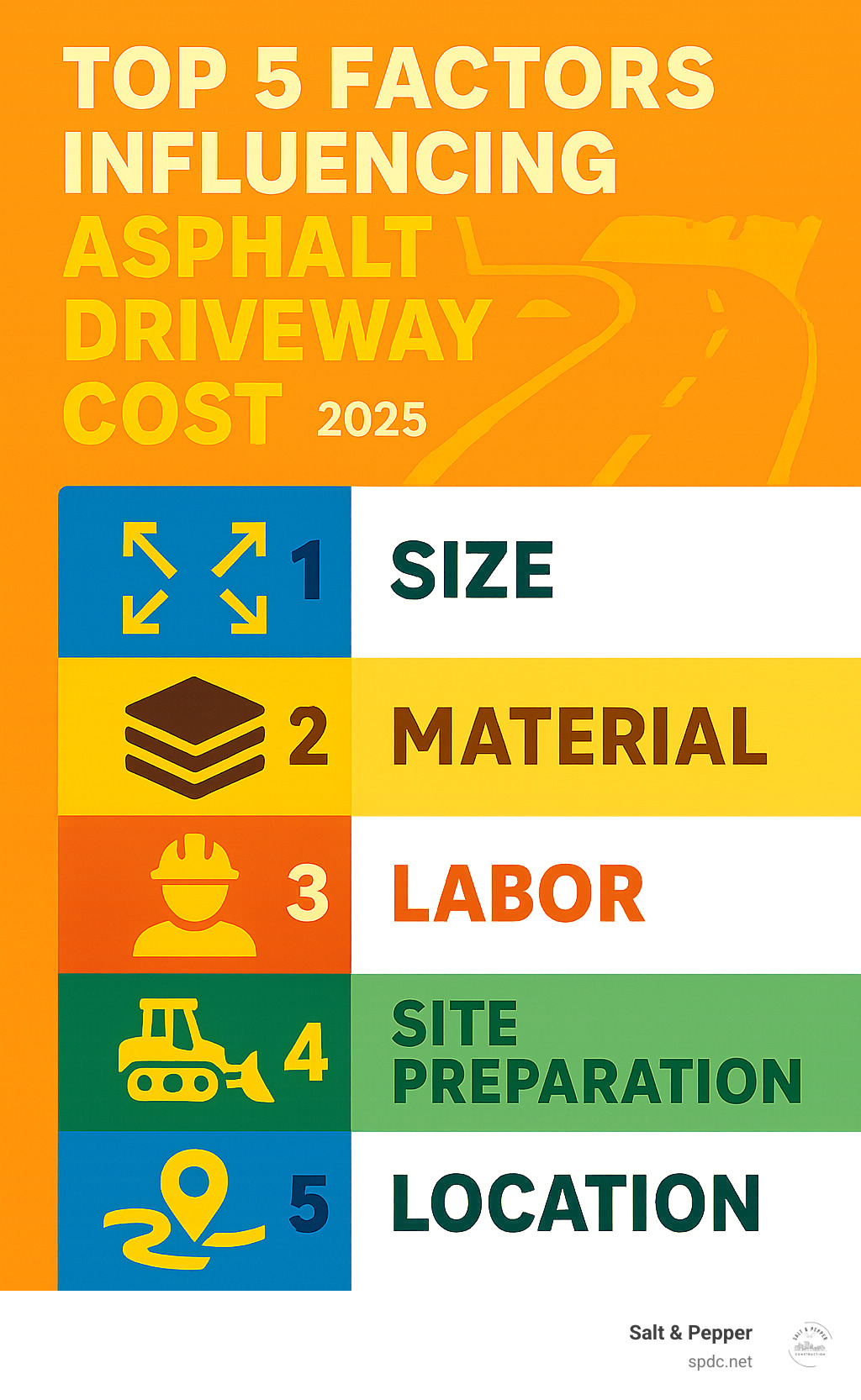
When you’re planning your driveway project, the asphalt driveway cost isn’t just about size and materials. Several important factors can make your final bill swing quite a bit higher or lower than you might expect.
Your property’s current condition plays a huge role in pricing. If you have a clean, level lot that’s ready to go, you’re in great shape. But if there’s an old driveway to tear out, trees to remove, or rocky soil to excavate, those extras add up fast. Tree and bush removal alone can tack on anywhere from $1,500 to $5,100 to your project.
The design of your driveway also matters more than you might think. A simple, straight rectangle is the most budget-friendly option. But if you’re dreaming of neat curves, multiple levels, or intricate patterns, expect to pay 15% to 30% more. Those beautiful custom designs require more skilled labor and careful equipment work.
Here in Florida, our climate definitely influences both the installation process and material choices. Our hot, humid summers and frequent afternoon thunderstorms mean timing is everything. The intense heat can actually help with asphalt curing, but heavy rains can delay projects and require special planning.
Seasonal demand can impact your wallet too. During peak paving season – typically summer and early fall when weather conditions are perfect – contractors stay busy and prices reflect that demand. If you’re flexible with timing and can schedule during slower periods, you might save 10% to 15% on your project.

At Salt & Pepper Construction, we believe in doing things right from start to finish. You can learn more info about our paving process to see how we handle every detail of your project.
Site Preparation and Grading
Think of site preparation as building the foundation for your foundation. It’s the behind-the-scenes work that makes or breaks your driveway’s long-term performance, and it’s a significant part of your asphalt driveway cost.
Excavation is often the first major expense. If you’re replacing an existing driveway, removing old asphalt or concrete typically adds $1 to $3 per square foot. The process involves breaking up the old surface, hauling it away, and preparing the area for new construction.
Grading and leveling might not sound glamorous, but it’s absolutely critical. This step shapes your ground to direct water away from your home and prevent pooling on your driveway. Poor drainage is one of the top reasons driveways fail early. Professional grading typically costs $5 to $10 per square foot, but it’s money well spent.
Drainage systems become especially important if your property has challenging water flow issues. While installing additional drainage adds to upfront costs, it protects both your new driveway and your property from water damage that could cost thousands down the road.
The base layer installation is where the real foundation work happens. A properly compacted gravel base of 6 to 8 inches provides the stability your asphalt needs. This base distributes weight evenly and prevents those annoying cracks and dips that can develop over time. The gravel base material typically runs $0.50 to $1.00 per square foot.
Quality site work isn’t just about making things look good – it’s about creating a driveway that will serve you well for decades. For more detailed technical information about proper site preparation, check out this helpful guidance on site work from HUD.
Asphalt Thickness and Quality
The thickness of your asphalt layer directly affects both durability and your asphalt driveway cost. It’s tempting to go thin to save money, but this often backfires with expensive repairs later.
For residential driveways handling typical family vehicles, we recommend 2 to 3 inches of compacted asphalt over a solid gravel base. This thickness handles cars, SUVs, and light trucks without breaking a sweat.
If your driveway needs to handle heavy vehicles like delivery trucks, RVs, or work vehicles regularly, you’ll want to go thicker. 3 to 4 inches of asphalt over an 8- to 10-inch base gives you the strength to handle those heavier loads without premature wear.
Hot mix asphalt is the gold standard for residential driveways. This material is produced at high temperatures, which creates a durable, smooth surface when properly installed and compacted. It’s what most contractors use because it delivers reliable, long-lasting results.
The impact on durability is straightforward – thicker, well-compacted asphalt over a robust base simply lasts longer. It resists cracking, rutting, and general wear much better than thin applications. Skimping on thickness might save money today, but often leads to costly repairs and shorter driveway life.
Of course, thicker asphalt means higher material costs and slightly more labor time for installation and compaction. But when you consider the impact on price versus long-term value, the extra investment typically pays for itself through extended driveway life.
Geographic Location
Where you live makes a bigger difference in your asphalt driveway cost than many homeowners realize. Regional factors can swing prices significantly, even within the same state.
Regional price differences are quite common across the country. Labor rates, material costs, and local regulations all vary from place to place. What costs $10 per square foot in one area might run $15 in another, simply due to local market conditions.
As a Tampa-based company, we understand the specific factors that affect pricing in our local market. Our deep knowledge of Tampa Bay area costs – including Clearwater and Riverview – helps us provide accurate, competitive estimates that reflect real local conditions.
Fuel costs have a direct impact on asphalt pricing since it’s a petroleum-based product. When oil prices rise, asphalt costs follow. Fuel prices also affect transportation costs for getting materials and equipment to your job site, especially if you’re in a more remote location.
Local material availability can significantly influence your project cost. If asphalt plants and quarries are nearby, material delivery is straightforward and affordable. But if materials need to travel long distances, those transportation costs get passed along to you.
Our Florida climate brings unique considerations that affect both material choices and installation timing. The intense heat and frequent rainfall influence how we schedule work and which asphalt mixes perform best. Sometimes porous asphalt makes sense for properties with drainage challenges, though it typically costs more than standard mixes. The key is matching the right materials and timing to our local conditions for the best long-term results.
Cost of Different Asphalt Driveway Projects
Understanding the nuances between installing a new driveway, replacing an old one, or simply resurfacing can help you steer the asphalt driveway cost landscape. Each option has a different process, price point, and ideal scenario.
| Project Type | Cost per Square Foot | Process | Ideal Conditions |
|---|---|---|---|
| New Installation | $7 – $13 | Involves excavating the area, laying a new gravel base, and paving with fresh asphalt. | For new construction or when no previous driveway exists. Also ideal if the existing driveway’s base has failed. |
| Replacement | $8 – $15 | The old driveway is completely removed, the sub-base is regraded and compacted, and new asphalt is installed. | When the existing driveway has extensive damage, such as deep cracks, potholes, or a failing foundation. |
| Resurfacing (Overlay) | $3 – $7 | A new layer of asphalt (1.5-2 inches) is applied over the existing driveway after cleaning and repairing minor cracks. | For driveways with a solid foundation but a worn-out surface. The existing driveway should have minimal cracks and no major structural issues. |
Understanding the Average Asphalt Driveway Cost
When considering a new asphalt driveway, budgeting is easier once you know the core numbers. Nationally, the asphalt driveway cost averages $7 to $15 per square foot for materials and professional installation. Most homeowners spend between $3,128 and $7,391, with an average around $5,258. For a 1,000 square foot driveway, plan on roughly $4,500 to $10,000 depending on site conditions and local rates.
- Materials: Typically $2 to $6 per square foot. Asphalt is petroleum-based, so its price moves with oil; expect about $100 to $200 per ton.
- Labor: Generally $1 to $7 per square foot, reflecting site prep complexity, access, and regional labor rates.
- Equipment and permits: Heavy machinery costs are usually included in bids; most municipalities require permits of about $50 to $200.
For a size-by-size overview and what drives pricing up or down, see the breakdown earlier in this guide.
Key Factors That Influence Paving Prices
Your final asphalt driveway cost depends on more than size and materials. Key drivers include site condition, design choices, climate, and seasonal demand.
- Site condition: Clearing, demolition, or rocky soil adds cost. Tree and bush removal can add $1,500 to $5,100.
- Driveway design: Curves, multiple turns, or varied widths often add 15% to 30% due to extra layout and labor.
- Climate and demand: In Florida, heat and rain affect scheduling and mix choices. Peak season (summer to early fall) can raise prices; off-season flexibility can save about 10% to 15%.
At Salt & Pepper Construction, we handle details end to end. You can learn More info about our paving process.
Site Preparation and Grading
Good site work is the backbone of long driveway life.
- Excavation and removal: Tearing out old asphalt or concrete typically adds $1 to $3 per square foot. Vegetation or obstacles increase costs.
- Grading and leveling: Proper drainage prevents early failure. Expect $5 to $10 per square foot for professional grading.
- Drainage: Add systems where water pools to protect your driveway and property.
- Base layer: Install 6 to 8 inches of compacted gravel (about $0.50 to $1.00 per square foot) for load distribution and stability. See this Guidance on site work from HUD.
Asphalt Thickness and Quality
- Typical residential: 2 to 3 inches of compacted asphalt over a solid gravel base.
- Heavy use: 3 to 4 inches of asphalt over an 8 to 10 inch base for RVs, delivery trucks, or frequent heavy loads.
- Mix: Hot mix asphalt is the residential standard. Thicker, well-compacted asphalt lasts longer but increases material and labor costs.
Geographic Location
- Regional differences: Labor rates, regulations, and supply vary by area; Tampa pricing reflects local conditions.
- Fuel costs: Asphalt and transport are tied to oil prices.
- Material availability: Proximity to asphalt plants and quarries affects delivered cost.
- Florida climate: Heat and rainfall guide scheduling and mix selection; in some cases, porous asphalt helps with drainage (often at a higher price point).
Cost of Different Asphalt Driveway Projects
Quick guide to typical ranges and use-cases:
- New installation: $7 to $13 per sq ft. Best for new construction or when the existing base has failed.
- Replacement: $8 to $15 per sq ft. Chosen when there is deep cracking, potholes, or a failing foundation.
- Resurfacing (overlay): $3 to $7 per sq ft. Works when the base is sound and the surface is worn but structurally stable.


